

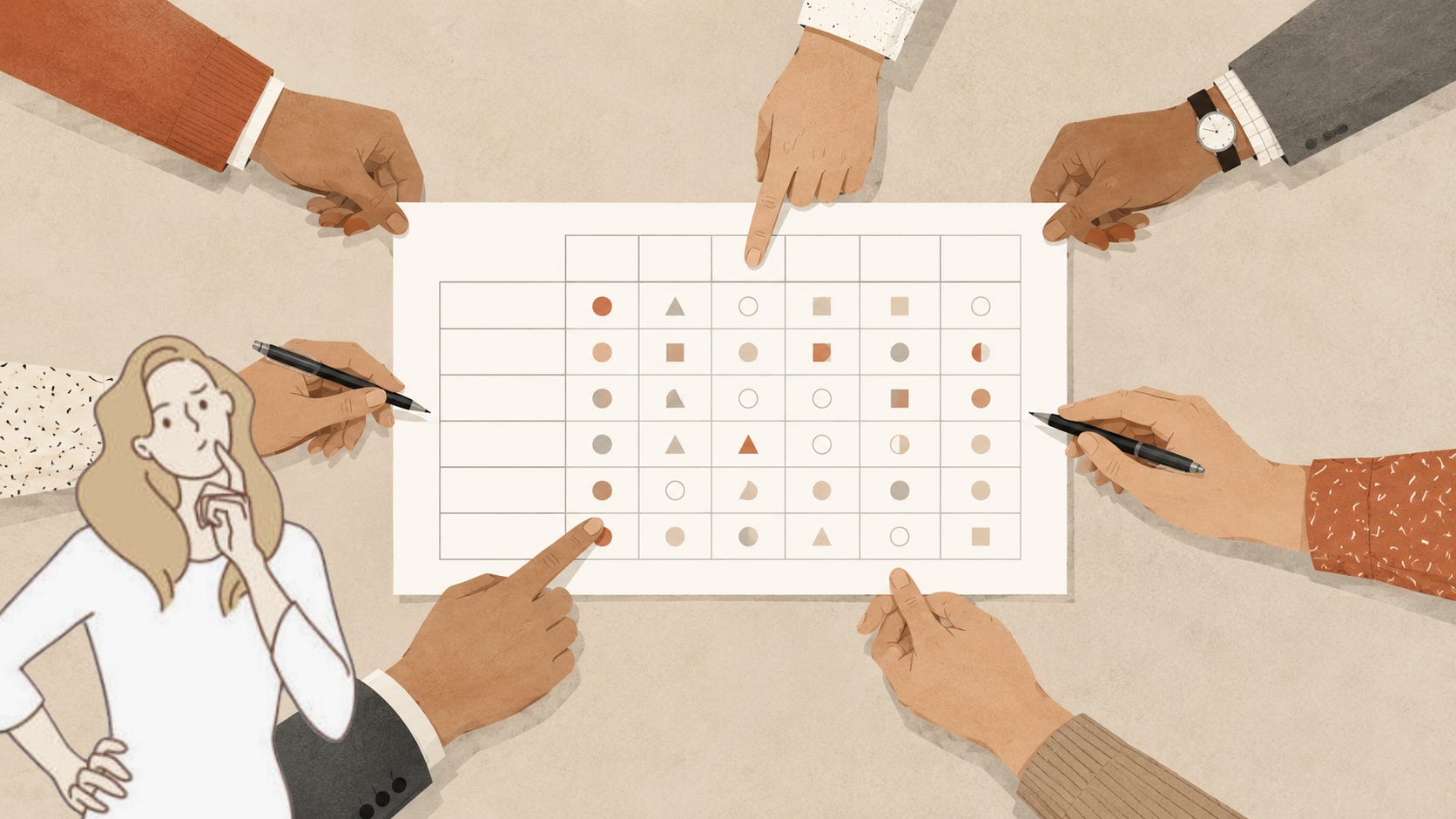
Most organisations I've worked in had some version of a decision rights framework. A RACI matrix, a governance charter, a set of approval authorities. They all looked sensible on paper. And almost none of them survived contact with a real meeting.
I've written before about how individuals can make better decisions - clearer framing, stress-testing assumptions, debiasing with better information and structured trade-offs and preparing to be wrong by building in contingency plans
However individual decision quality doesn't scale automatically. The harder problem is what happens when a group of people - with different roles, different information, and different incentives - need to decide together.
Frameworks aren't the problem
This is usually where decision rights frameworks come in.
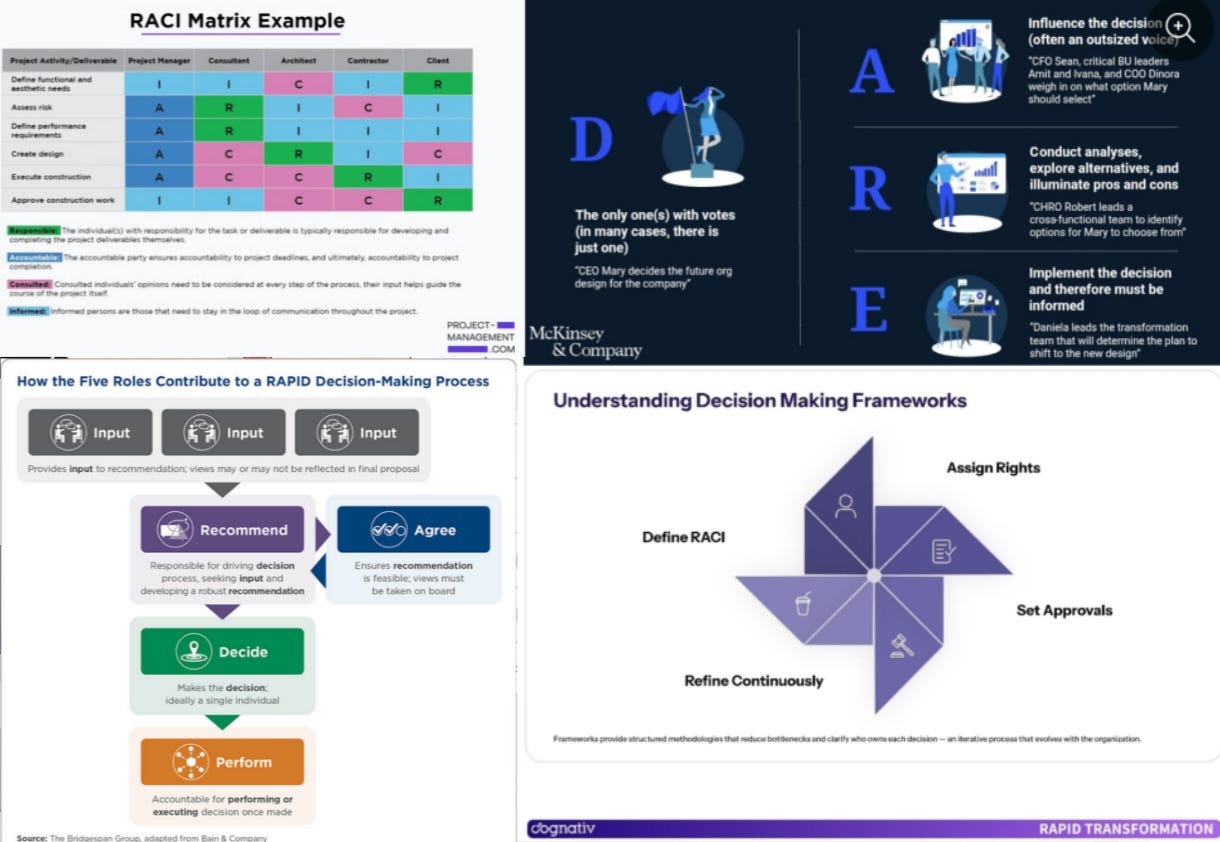
Every major consultancy has a tool for clarifying roles within complex organizational decision processes. Whether it's RACI, DACI or other proprietary frameworks like BCG's OVIS, Bain & Co’s RAPID®, McKinsey's DARE - they all answer the same basic question: Who actually has the authority to make the final call and how is everyone else involved in the decision process ?
A recent HBR article studied why these frameworks keep failing in practice and identified four common mistakes : assigning decision roles before the group has aligned on goals, treating decision rights as a static spreadsheet handed down by a senior leader rather than co-created, people disagreeing on what the roles actually mean in practice, and hierarchy overriding the assigned roles when it matters most.
It's a great article and worth a read but really these felt like symptoms of a deeper issue : Many organisations still treat decision-making as a policy / documentation problem - who has which role on the spreadsheet - rather than a behaviour problem: how people actually act when the stakes are real and hierarchy (& politics) enter the room.
As one manager quoted in the article put it: "Decision rights are like the position plan for a children's soccer game - a nice plan on paper that no one understands or remembers."
Where behaviour defeats the framework
This plays out in three ways that anyone who's worked in a matrixed organisation will recognise.
The first is hierarchy overriding the framework - or sometimes, knowing when not to use it. The obvious version: the boss shows up and the designated decision-maker defers. But there's a subtler failure. I spent two years as a joint venture technical liaison on a multi-billion dollar offshore gas development. My organisation was a non-operating minority partner. On paper, we had the contractual right to block budget approvals and key technical decisions.
But wielding that authority bluntly would have poisoned the partnership. Our role was to surface risks and evaluate whether the operator had equivalent controls for the uncertainties we'd identified - not to dictate strategy. Getting to a smooth final investment decision meant calibrating every recommendation to build trust rather than erode it. The formal controls existed. The joint operating agreement was clear. But the decision worked because of the behaviours around those controls - not the controls in themselves.
The second is the absence of shared purpose underneath the roles. Decision rights frameworks assign mechanics - who decides, who inputs, who gets informed. But they skip the harder question: do the people in the room share a common understanding of what they’re trying to achieve? I’ve sat in governance meetings where everyone had clearly defined roles - and the meeting still went in circles because half the room was optimising for speed to market and the other half for cost discipline. The RACI was technically correct. The misalignment on what a good outcome actually looked like made it irrelevant. Without that alignment, roles become turf and consultation becomes box-ticking.
The third is the quiet symptom of the first two: when decision rights are murky, organisations default to demanding more data & analysis. When nobody is clear who actually owns the call - or when the designated decision-maker keeps deferring upwards or requesting “just one more round of analysis” - more data becomes a substitute for the decision nobody wants to make. This is how zombie projects survive - not because anyone champions them, but because nobody has the authority or courage to kill them. The fix isn’t better dashboards. It’s being clear about what needs to be decided, who’s deciding it, and what information that decision genuinely requires.
This gets harder with automation

As enterprises move towards more automated and agentic AI workflows, the decision rights question becomes more urgent, not less.
Beyond where the human-in-the-loop sits, the real question is: who owns accountability when decisions are executed by algorithms? Who has override or veto rights? And how do you ensure the rules governing automated decisions were themselves the product of good decision-making?
Without clear decision architecture, automation doesn't remove ambiguity. It scales it.
What actually helps
Having navigated decision governance across capital projects, joint ventures, and global supply chain operations, here's what I have seen that works :
Co-create, don't hand down. The best governance frameworks I've seen weren't the cleanest documents - they were the ones that surfaced tensions that needed surfacing anyway. The conversation about roles matters more than the document it produces.
Flex roles by decision type, not by seniority. The question isn't "who's most senior?" but "who's closest to this decision with the most relevant perspective?" In practice, this requires leaders to actively step back - and organisations to genuinely let them.
Align on purpose before assigning roles. Before debating who decides, make sure the group agrees on what they're deciding for. Without this, every RACI discussion becomes a proxy war.
Treat it as a practice, not a one-time exercise. The best teams regularly asked: did we play our positions? Where did we override the framework - and was that the right call? Decision governance that isn't revisited becomes wallpaper.
The gap is behavioural, not structural
The tools exist. RACI, RAPID, DARE - they all work fine on paper. The gap is in the space between the document and the behaviour: whether people actually trust each other enough to play their roles, whether they share enough common purpose to make trade-offs together, and whether the information reaching the decision is calibrated to what the decision actually needs.
Decision quality starts with the individual. But it scales through how groups design the conversations around decisions - not just the roles on a spreadsheet.

As per the main article, the problem ISN'T inherently the decision rights frameworks but managing behaviours during implementation.
Having said that, I thought it'd still be useful to share a handy reference for anyone wanting a more detailed look at the various approaches mentioned :
- RACI Responsible Accountable Consulted Informed https://www.projectmanagement.com/wikis/234008/raci
- DACI Driver Approver Contributer Informed https://interfacing.com/daci-raci-rasci
- BCG's OVIS Owner Veto-Holder Influencer Supporter https://www.bcg.com/industries/public-sector/decision-rights-using-ovis-framework
- Bain & Co's RAPID Recommend Agree Perform Input Decide https://www.bain.com/insights/rapid-decision-making/
- McKinsey's DARE Decide Advise Recommend Execute https://www.mckinsey.com/capabilities/people-and-organizational-performance/our-insights/the-organization-blog/the-limits-of-raci-and-a-better-way-to-make-decisions